

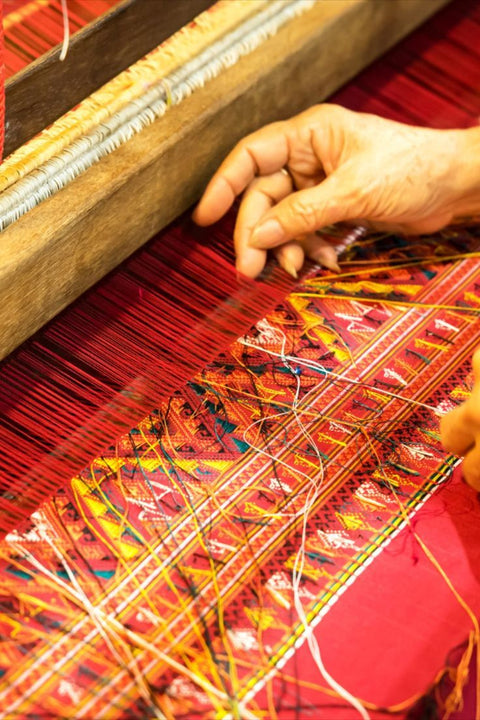
Brocade Weaving Process: Cultural Heritage Embroidered on Fabric
The process of weaving brocade is not simply about making clothes – it is the living heritage of ethnic groups, the story of the hands, the memory and the indigenous spirit passed down through each thread.
What is Brocade Weaving? And Why Is It Considered an “Art of Living” of Ethnic Minorities?
Brocade – in Vietnamese culture – is not just a colorful fabric. It is a non-verbal language that ethnic women use to tell stories: about their clan, about the mountains and forests, about rituals and beliefs. Each pattern and motif has a deep symbolism – no detail is random.
Unlike industrial fabrics, brocade fabrics are woven entirely by hand , using traditional looms – a technique passed down from mother to daughter, from generation to generation. And it is this craftsmanship that creates the irreplaceable value of each piece of fabric – because no two are alike.

(Photo: Pinterest)
How many stages are there in the brocade weaving process?
Weaving brocade is an elaborate, meticulous and highly technical process, usually going through 5 main stages :
1. Prepare Materials – Natural Fibers
Workers use cotton, hemp or flax fibers, harvested from nature. After drying, separating and spinning, the raw materials are spun into even threads, ready for dyeing.
2. Yarn Dyeing – Color from Leaves, Roots, and Barks
The special feature of brocade is the use of natural dyes from forest trees: red from vang tree roots, black from nghien tree bark, blue from indigo leaves... The color develops slowly, needs to be soaked for many days, dried many times and always requires extremely delicate calibrated by the craftsman.
3. Setting Up the Loom – Correctly Aligning the Thread
The loom is usually made of wood, hand-built with the right tension so that when weaving, the fabric surface is even and smooth. The “framing” requires extremely precise technique of arranging the warp threads – just a few threads off will make the pattern completely wrong.
4. Weaving – The Most Time-Taking Step
The weaver uses a shuttle to thread the thread across each row, alternating the colored threads according to a pre-determined pattern in his mind. There are no blueprints, no machines – just experience and memory. A small piece of cloth can take days, even months, to complete.
5. Finishing – Smoothing, Cutting, Storing
After weaving, the fabric is dried and gently washed to stabilize the color. Depending on the purpose, the fabric can be used to make dresses, shirts, bags, scarves or interior decoration. In many places, each family has its own pattern – almost a “fabric fingerprint” representing the community in which they live.

(Photo: Pinterest)
The Value of Brocade Fabric Is Not in the Product – But in the Process
In today’s fast fashion world, people are used to buying a shirt in minutes. But with brocade, it takes weeks to make a piece of fabric . This makes each brocade product a living heritage – it cannot be copied, cannot be duplicated, can only be remade by the same hands.
Brocade is not only expensive because of the craftsmanship – but also because of its meaning. It is a symbol of hard work, indigenous aesthetics and the spirit of preserving tradition in the digital age.
From Heritage to Style: When Brocade “Steps Out into the Street”
Today, brocade is not only found in the wedding wardrobe of the Mong people or the festival dresses of the Thai people. Young designers are looking to “transform” this value into everyday life – by incorporating brocade into streetwear, oversized coats, boho accessories or modern shape designs .
Bringing brocade to the streets does not destroy its traditional value – on the contrary, it helps brocade fabric “live” with the new generation, in a new context. From a native item, brocade gradually becomes an aesthetic statement associated with cultural identity .

(Photo: Pinterest)
Conclude
The process of weaving brocade is a testament to a form of fashion that does not follow the market, does not imitate , but lives on memory and belief. Each piece of fabric is not only the result of manual labor, but also a part of the national soul – present in every pattern, every shuttle, every thread.
In the world of fast-fashioning, compact-fitting, trendy dressing, perhaps it's time we take a step back and ask: What am I wearing? And what story does it have to tell?
Related articles:
Where Do Natural Fibers Come From? Why Are They Increasingly Popular?
Fabric Handbags – When Accessories Become a Statement of Stylish Lifestyle